

A split body web guide is a crucial component in many industrial processes involving the handling of continuous webs of materials such as paper, film, and fabric. As a supplier of split body web guides, I am often asked about how these devices work. In this blog post, I will delve into the working principle of a split body web guide, highlighting its significance and applications in industrial settings.
Basic Concept of a Web Guide
Before we discuss the split body web guide specifically, it's important to understand the general concept of a web guide. A web guide is a device that ensures the accurate positioning of a moving web of material. In various industries, maintaining the proper alignment of the web is essential for product quality and process efficiency. Misalignment can lead to issues such as wrinkles, edge tears, and uneven coating, which ultimately affect the final product's quality and may cause production downtime.
Anatomy of a Split Body Web Guide
A split body web guide consists of two main parts that are separated, or "split," along the web path. This design allows for easy installation and maintenance, especially in applications where the web is already in place or when quick access to the guide components is required. The split body design typically includes the following key components:

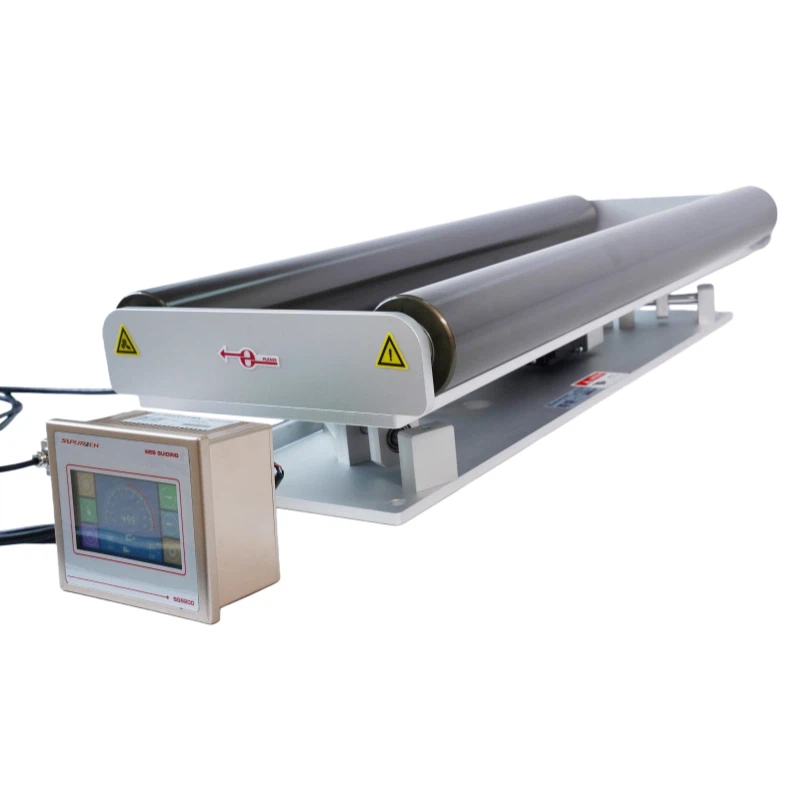
- Sensor Unit: This is the part that detects the position of the web edges. There are different types of sensors used in split body web guides, such as optical sensors, ultrasonic sensors, and capacitive sensors. The sensor continuously monitors the web's position and sends signals to the control unit.
- Control Unit: The control unit receives the signals from the sensor and processes the data. It then calculates the necessary adjustments to keep the web in the correct position. Based on the calculated values, the control unit sends commands to the actuator.
- Actuator: The actuator is responsible for physically moving the guide rollers or other guiding elements to adjust the web's path. Common types of actuators include pneumatic cylinders, electric motors, and hydraulic systems. The actuator responds to the commands from the control unit and makes precise movements to correct the web alignment.
Working Principle in Detail
1. Web Edge Detection
The process begins with the sensor unit detecting the position of the web edge. For example, an optical sensor emits light towards the web edge. When the web edge moves, the amount of light reflected back to the sensor changes. The sensor then converts this change in light intensity into an electrical signal. Ultrasonic sensors work on a similar principle, but they use ultrasonic waves instead of light. Capacitive sensors detect changes in capacitance caused by the presence of the web edge.
2. Signal Transmission and Processing
Once the sensor has detected the web edge position, it sends an electrical signal to the control unit. The control unit is equipped with sophisticated algorithms and electronics to process this signal. It compares the current web position with the desired position, which is pre - set by the operator. If there is a deviation between the two positions, the control unit calculates the amount and direction of the adjustment needed to bring the web back to the correct position.
3. Actuator Response
After the control unit has calculated the necessary adjustments, it sends commands to the actuator. For instance, if a pneumatic actuator is used, the control unit will regulate the air pressure to the cylinder. An increase or decrease in air pressure will cause the cylinder rod to extend or retract, respectively. This movement is transferred to the guide rollers, which then shift the position of the web. Electric actuators work by controlling the rotation of an electric motor, which in turn moves the guiding elements.
4. Continuous Monitoring and Adjustment
The split body web guide operates in a closed - loop control system. This means that the sensor continuously monitors the web position, and the control unit and actuator make continuous adjustments as needed. As the web moves through the process, any changes in its position due to factors such as tension variations, material irregularities, or machine vibrations are quickly detected and corrected.
Applications of Split Body Web Guides
Split body web guides are widely used in a variety of industries, including:
- Printing Industry: In printing presses, accurate web alignment is crucial for ensuring that the printed images are properly registered. A split body web guide helps to keep the paper or film web in the correct position throughout the printing process, resulting in high - quality prints.
- Packaging Industry: When packaging materials such as plastic films and paperboards are being processed, a split body web guide ensures that the materials are cut and sealed correctly. This improves the overall appearance and functionality of the packaging products.
- Textile Industry: In textile manufacturing, webs of fabric need to be guided accurately during processes such as weaving, dyeing, and finishing. A split body web guide helps to prevent fabric distortions and ensure consistent quality.
Advantages of Split Body Web Guides
- Easy Installation: The split body design allows for easy installation in existing production lines without the need to disassemble large parts of the machinery. This reduces downtime during installation and maintenance.
- High Precision: With advanced sensors and control systems, split body web guides can achieve high levels of alignment accuracy, ensuring the quality of the final product.
- Flexibility: They can be easily adjusted to accommodate different web widths and materials, making them suitable for a wide range of applications.
Related Products
As a supplier, we offer a range of related products in addition to split body web guides. You can explore our Web Guide Steering Frame, which provides a stable and precise framework for web guiding. Our Web Winding Guide is designed specifically for winding applications, ensuring uniform and tight winding of the web. We also have a Web Guide with Splice Table, which combines web guiding functionality with a splicing device for seamless web joining. And for a more integrated solution, our All-in-one Web Guide offers a comprehensive package for web handling.
Contact for Purchase and Consultation
If you are interested in our split body web guides or any of our other web guiding products, we are here to assist you. Whether you need more detailed technical information, a product demonstration, or a customized solution for your specific application, please don't hesitate to contact us. We have a team of experienced professionals who can provide you with the best advice and support to meet your industrial web handling needs.
References
- "Web Handling: Principles and Practice" by David Roisum.
- "Industrial Automation Handbook" edited by Thomas Kurfess.